












After 93 years, local company still serving up linguica
 Linguica is processed at the factory. BY DOUGLAS MCCULLOCH
 Robert Gaspar, who runs Gaspar's Sausage Company along with his cousin Charles Gaspar, stands in front of the counter at the company's factory store. BY DOUGLAS MCCULLOCH
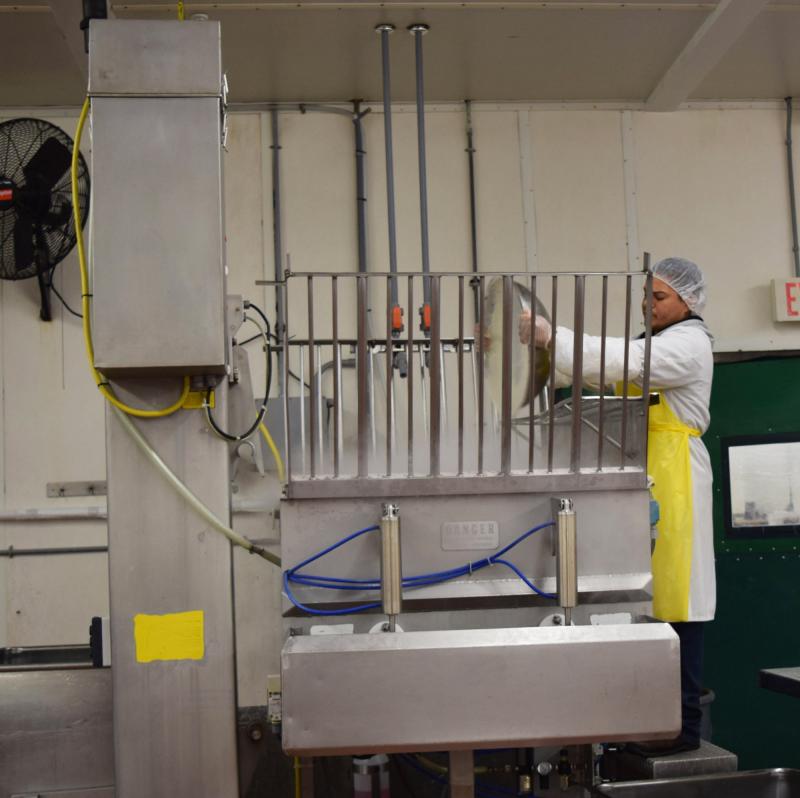 An employee adds meat to a mixer that blends it with spices. BY DOUGLAS MCCULLOCH
 After spices are added, the meat sits overnight to absorb the flavor. BY DOUGLAS MCCULLOCH
 An employee attaches a length of casing to a machine to stuff the linguica with. BY DOUGLAS MCCULLOCH
 Meat waits in a climate-controlled room before it is packaged. BY DOUGLAS MCCULLOCH
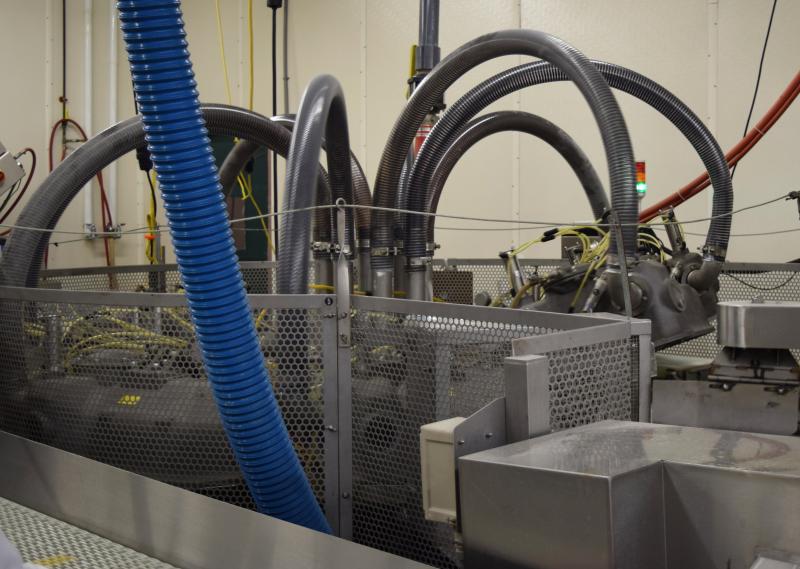 A large machine called a Cryovac automates the packaging process. BY DOUGLAS MCCULLOCH
 An employee oversees the Cryovac. BY DOUGLAS MCCULLOCH
 A fully packaged bag of meat emerges from the Cryovac and a machine that removes excess moisture and air from the packaging. BY DOUGLAS MCCULLOCH
Linguica is processed at the factory. BY DOUGLAS MCCULLOCH
Robert Gaspar, who runs Gaspar's Sausage Company along with his cousin Charles Gaspar, stands in front of the counter at the company's factory store. BY DOUGLAS MCCULLOCH
An employee adds meat to a mixer that blends it with spices. BY DOUGLAS MCCULLOCH
After spices are added, the meat sits overnight to absorb the flavor. BY DOUGLAS MCCULLOCH
An employee attaches a length of casing to a machine to stuff the linguica with. BY DOUGLAS MCCULLOCH
Meat waits in a climate-controlled room before it is packaged. BY DOUGLAS MCCULLOCH
A large machine called a Cryovac automates the packaging process. BY DOUGLAS MCCULLOCH
An employee oversees the Cryovac. BY DOUGLAS MCCULLOCH
A fully packaged bag of meat emerges from the Cryovac and a machine that removes excess moisture and air from the packaging. BY DOUGLAS MCCULLOCH
Story Location
United States
It’s a typical day at Gaspar's Sausage Company. Throughout the factory on Faunce Corner Road, employees propel the company’s signature linguica, chourico, and other sausages through a maze of machinery before sending them out to market, using recipes perfected more than 90 years ago.
What began as a small family business operating out of a garage in New Bedford has grown into one of the largest sausage companies in the United States, processing over four million pounds of sausage every year. According to current owner Robert Gaspar, who runs the company along with his cousin Charles Gaspar, the company continues to grow every year.
Gaspar, who is a third generation employee of the company, learned the tricks of his trade from his grandparents and company founders, Manuel and Justina Gaspar. The couple first immigrated to the United States from Portugal in 1912, settling in East Providence where they opened up a grocery store.
In 1923, they founded Gaspar’s Sausage Company.
“[Justina] lived on a farm in Portugal. Back then, the men would slaughter the hogs and the women would dress the meat. It was her recipe she brought to this country,” Gaspar said.
At the time, the business operated out of the garage of a home on Circuit Street in New Bedford. All five Gaspar children—including Robert's father Fernando—worked at the company. It survived a number of hardships, including the Great Depression and the departure of three Gaspar children to fight in World War II. All three returned to work when the war ended.
“During the Great Depression it was difficult, the meat was not readily available,” Gaspar recalled.
In the early 1950s, the company experienced growing pains. The family relocated its garage-based operation to a new factory at the intersection of Dartmouth Street and Rockdale Avenue, where a Cumberland Farms now stands.
Now, fifth-generation Gaspars work the factory at Faunce Corner Road. The latest relocation for the still family-run business happened in 1980.
“It’s very rare that you find a family business that will go beyond the third generation,” Gaspar said.
While the Gaspar family still uses the original recipe for its linguica and chourico sausages, it has expanded its offerings over the years to include Polish kielbasa and Mexican chorizo. The biggest changes, however, derive from technological developments.
“The whole manufacturing process has changed, much of our equipment is now computerized,” Gaspar said. He added that new technology also benefits the company from a sales perspective, as meat can be ordered online, via fax, and by phone.
Despite new tech, creating linguica is still a three-day process. First, pork is brought in from farms in the Midwest in 80-pound boxes. The meat is ground in-house, combined with spices, and left to sit overnight.
“You have to let the meat set overnight so the spices can permeate and marinate the meat,” Gaspar said.
The next day, workers stuff spiced meat into casings—Gaspar’s uses hog intestines—before placing the sausages into a smoker. On the third day, the final product is packaged and shipped to its destination.
“That’s the way my grandmother did it. We stick to the same recipe,” Gaspar said. “It works really well.”
For locals, the company operates a factory outlet at its Faunce Corner Road facility, which is stocked with meat fresh from the factory floor. The outlet is open on weekdays, 8 a.m.–4 p.m.
Event Date