











UMass Dartmouth celebrates Martin Luther King Jr.'s memory at 24th annual breakfast
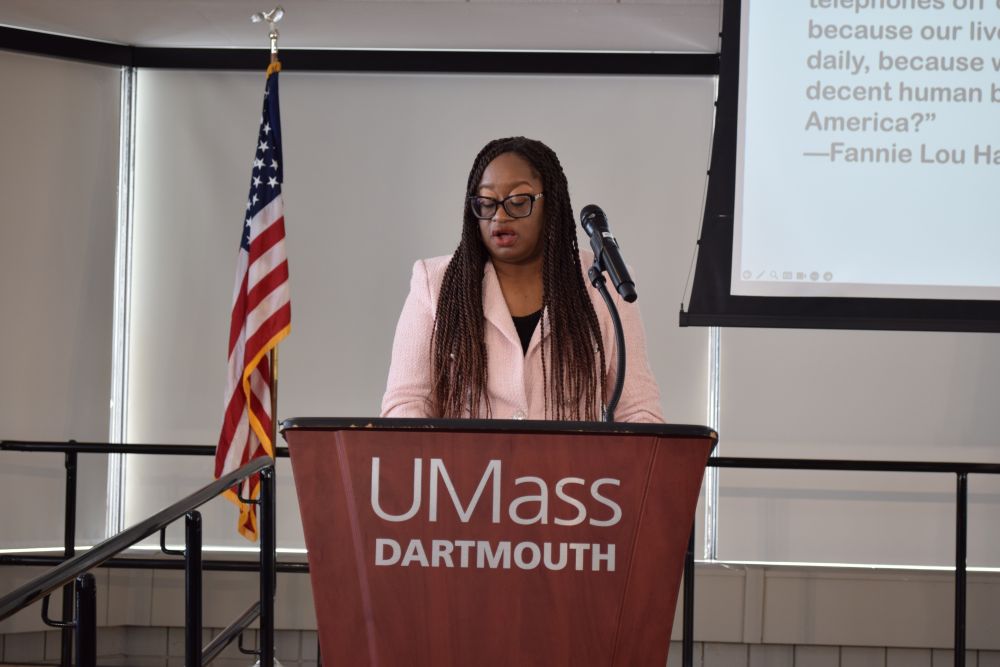 Dr. Keisha Blain gives her keynote speech. Photos by Kat Sheridan
 The crowd applauds for a speaker.
 Reverend Lauri Smalls sings.
  Guests customize some waffles.
  David Gomes introduces the speakers.
 Dr. Keisha Blain signs a copy of her book.
  A group of students enjoy the breakfast.
 The Unique Sound Band.
 Laurajane Fitzsimons and Vera Delgado.
  Cassy L. De Pina introduces the keynote speech.
 Chancellor Mark Fuller speaks about the importance of events like this.
 Cassy L. De Pina gives Dr. Keisha Blain her trophy.
  The Gomes family poses for a photo.
Dr. Keisha Blain gives her keynote speech. Photos by Kat Sheridan
The crowd applauds for a speaker.
Reverend Lauri Smalls sings.
Guests customize some waffles.
David Gomes introduces the speakers.
Dr. Keisha Blain signs a copy of her book.
A group of students enjoy the breakfast.
The Unique Sound Band.
Laurajane Fitzsimons and Vera Delgado.
Cassy L. De Pina introduces the keynote speech.
Chancellor Mark Fuller speaks about the importance of events like this.
Cassy L. De Pina gives Dr. Keisha Blain her trophy.
The Gomes family poses for a photo.
The Gomes family poses for a photo.
Dr. Keisha Blain gives her keynote speech. Photos by Kat Sheridan
The crowd applauds for a speaker.
Reverend Lauri Smalls sings.
Guests customize some waffles.
David Gomes introduces the speakers.
Dr. Keisha Blain signs a copy of her book.
A group of students enjoy the breakfast.
The Unique Sound Band.
Laurajane Fitzsimons and Vera Delgado.
Cassy L. De Pina introduces the keynote speech.
Chancellor Mark Fuller speaks about the importance of events like this.
Cassy L. De Pina gives Dr. Keisha Blain her trophy.
The Gomes family poses for a photo.
“I want you to know the names,” said Reverend Martin Luther King Jr. in the ‘I've Been to the Mountaintop’ speech that he gave on April 3, 1968, “That we and the people will get to the promised land.”
UMass Dartmouth held their 24th annual Martin Luther King Jr. Breakfast on Friday, Jan. 30. Ticket sales support the Office of Civil Rights, with events such as this.
“We need to be reminded about America and what America stands for,” said Chief Civil Rights Officer David Gomes. “Justice, liberty, freedom of speech, equity, justice, inclusion. Dr. King is the epitome, the personification of that. It’s an honor to honor that legacy.”
Around 250 people were in attendance, with many coming from Dartmouth High School, the New Bedford National Association for the Advancement of Colored People and YMCA Southcoast.
Every year the theme is around the keynote speaker, and this year this speaker was historian Dr. Keisha N. Blain, who focused on the role of Black women leaders during the civil rights movement.
The event started with the Unique Sound Band playing while guests had breakfast. Reverend Lauri Smalls began and ended the event with songs. She opened the event with “Lift Ev’ry Voice and Sing,” which is known as “The Black National Anthem.”
During her speech, Blain spoke about women leaders during the Civil Rights movement, with a focus on Fannie Lou Hamer.
“I found it very enlightening to hear about civil rights figures that I had not heard about during high school and during my classes here,” said Nazim Cisse, a junior at UMass Dartmouth who is a part of student government, “So it was definitely something worth attending and it was a very fun event, so I’m very glad I came.”
Fannie Lou Hamer was a leader in the movement to get the right to vote in Mississippi, after attending a meeting held by SNCC, Student Nonviolent Coordinating Committee, that argued that America could be transformed through the power of the vote.
She was kicked out of the plantation she lived on, beaten and arrested for registering to vote as well as her activism for Black Americans to have the right to vote.
During the 1960s, only 5% of the Black residents of Mississippi were registered to vote, having to fight registration taxes and literacy tests.
Hamer helped host the Freedom Vote to show that contrary to the stereotype, Black people wanted the right to vote. An estimated 80,000 to 90,000 Black residents came out to participate in the vote.
“The United States could not claim to be a democracy while withholding voting rights from millions of citizens,” said Blain.
Hamer attended and spoke at the Democratic National Convention in [year], and gave a speech asking Americans whether they wanted to live where people were threatened if they tried to vote or be decent human beings, which was aired and seen by millions. Later, president Lyndon B. Johnson passed legislation banning restrictive laws that blocked Black voters from voting.
“Is this America, the land of the free and the home of the brave, where we have to sleep with our telephones off the hooks because our lives be threatened daily, because we want to live as decent human beings, in America?” asked Hamer during her speech at the Democratic National Convention.
After the keynote, student speaker Cassy L. De Pina awarded Blain a trophy as a token of appreciation for the speech.
Two of Blain’s books were for sale during the event, “Wake Up” and “Without Fear,” which she signed after her speech.
“[Planning the breakfast] is like making Thanksgiving dinner because you do all the planning and it's a lot of effort and coordination and it's done,” said Gomes. “I thought this was a great breakfast experience, I like to think people enjoy themselves.”