











Ninth Bristol District State Representative debate
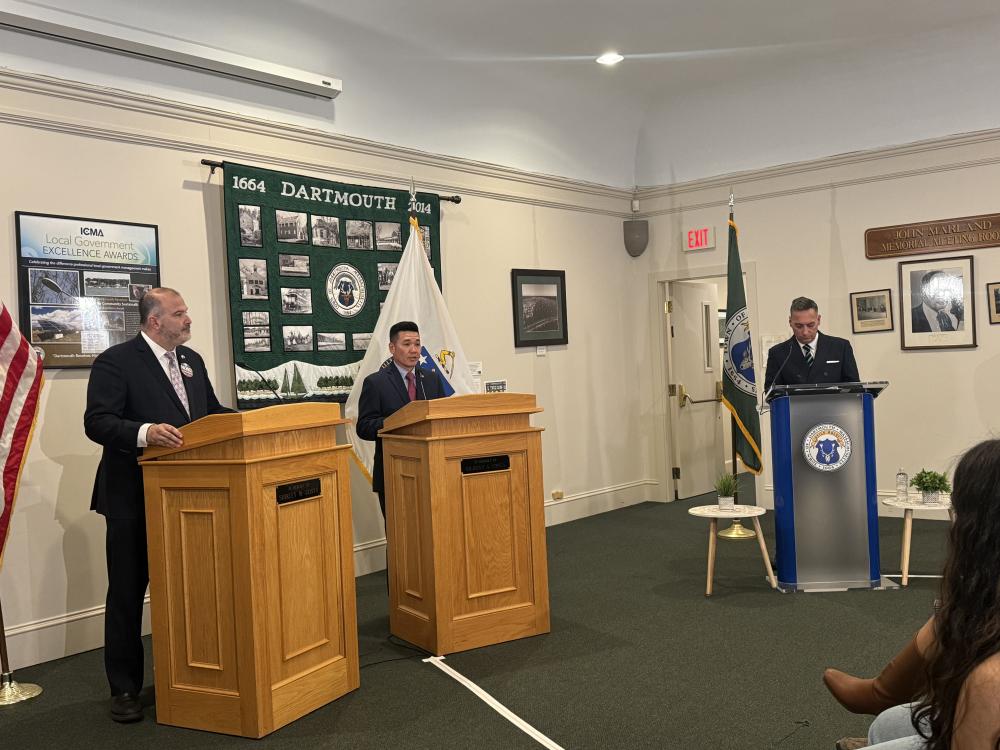 Ed Pacheco and Chester Tam debated. Photo by Kat Sheridan
Ed Pacheco and Chester Tam debated. Photo by Kat Sheridan
Ed Pacheco and Chester Tam debated. Photo by Kat Sheridan
The two candidates for Ninth Bristol County State Representative, moderate Democrat Edward Pacheco and conservative Republican Chester Tam faced off for a debate on Thursday, Oct. 8.
The debate was hosted by Dartmouth Community Media, the Democratic Town Committee and the Republican Town Committee. Paul Santos moderated the debate.
The event started with an opening statement from each candidate. Then Republican Committee chair Margaret Sweet would ask a question, followed by Democratic Chair James Griffith, and a question from the general public read by Santos.
The candidates went back and forth answering first, with the first receiving two minutes and the second receiving a minute and a half. The 15 questions revolved around local topics rather than broader political topics.
The debate ended with a three minute closing statement.
Pacheco was a small business owner, and now works as a director for a non-profit. Based on his campaigning where he knocked on over 6,000 doors he found people wanted someone asking questions on Beacon Hill. He wants to represent everyone in the district, regardless of party affiliation.
“They want a representative who is going to be present, active and willing to ask hard questions on Beacon Hill,” said Pacheco, “I’m that person.”
Tam worked at his parents' restaurant before working in technology and the private sector. He decided to run as years ago his wife and he were debating whether to move or not due to costs. They stayed as Massachusetts is “home.” He feels the issue is with statewide programs and needs to reallocate funds.
“People need to live within their means, so should the government,” said Tam.
There were multiple topics that the candidates agreed on, such as that state funds need to be redistributed to the towns and cities, that Ballot Question 9 on reforming gun laws should not be passed and the state audit should be conducted. Both quoted pasts in small businesses as to why they should be trusted with the budgets.
However, they had differing views on how state funds should be reallocated. Tam wants to have more of the Millionaires Tax, which taxes those with $1,000,000 in income an extra 4% on all income over a million. Pacheco wants to reevaluate state laws 40, 70 and 90 that distribute funds, as well as tax offshore accounts more than the current 5%.
While both Tam and Pacheco are concerned about Chapter 40B, their views differ slightly. Pacheco wants to amend 40B to be more accommodating as affordable housing is necessary. Tam stated he agreed, but that 40B should be more locally controlled.
Both also have plans to be accessible to the constituents. Pacheco would publish a weekly newsletter explaining his actions as State Representative and have a monthly meeting in both New Bedford and Dartmouth. Tam would open an office in Dartmouth.
One of the main issues that the two disagreed on was protecting low-lying coastlines from climate change based flooding. Pacheco stated finding ways to use federal and state funds, supporting Net 0, creating stronger infrastructure and shoring up the shore lines. Tam feels that this is not an issue, quoting visiting Plymouth Rock and it being unaffected. However, he did state stronger infrastructure is important.
Neither supports Ballot Question Seven, but have different plans on battling this should it pass. Pacheco would make amendments to 40B and have like-minded coastal communities through a Coastal Commission as back up. Tam stated he would fight it “tooth and nail.”
The other was on state programs. Pacheco wants to explore state-wide programs like universal Medicare and childcare, while Tam feels this money should go to local communities instead.
One of the last questions was on what three actions the candidate would sponsor every two years if voted in. Tam stated he would look for funding for the New Bedford Fire Station Nine, a bill to support unrestricted local aid and infrastructure assistance. Pacheco stated a lot of this could be fixed with local funding, such as Station Nine. His other actions would be to work on the funding formulas that decide how much state aid goes to towns and cities such as chapters 70 and 90, and reevaluate systems protecting consumers from energy bills with audits.
To watch the full debate, visit DCTV on YouTube.