











Water rates may increase by 13% as town looks to address deficit
 Four areas where heightened expenses are found. Source: DCTV
 The change in how much Dartmouth has paid New Bedford for water compared to the budget from 2020 through the present fiscal year.
 Retained earnings have been decreasing since Fiscal Year 2020 with the current retained earnings balance approximately at $140,000.
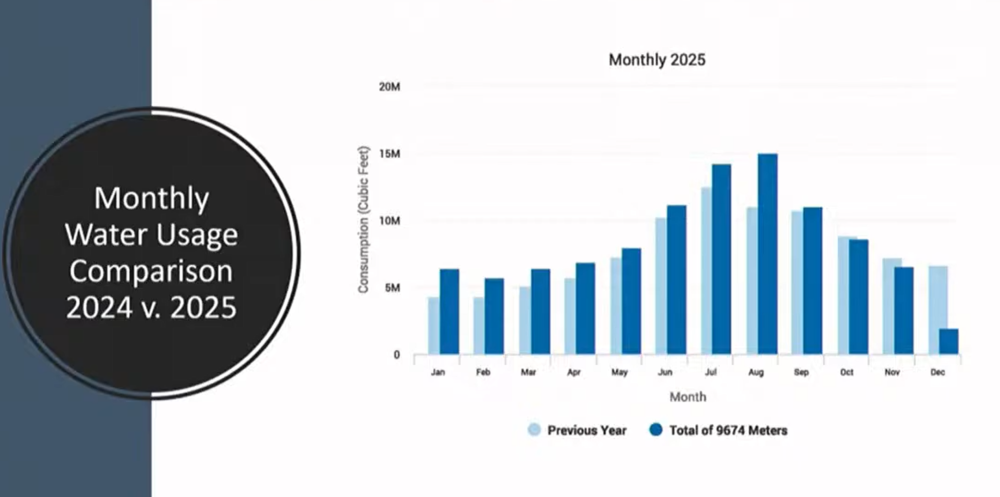 A comparison of how many gallons of water were used each month in 2024 versus 2025.
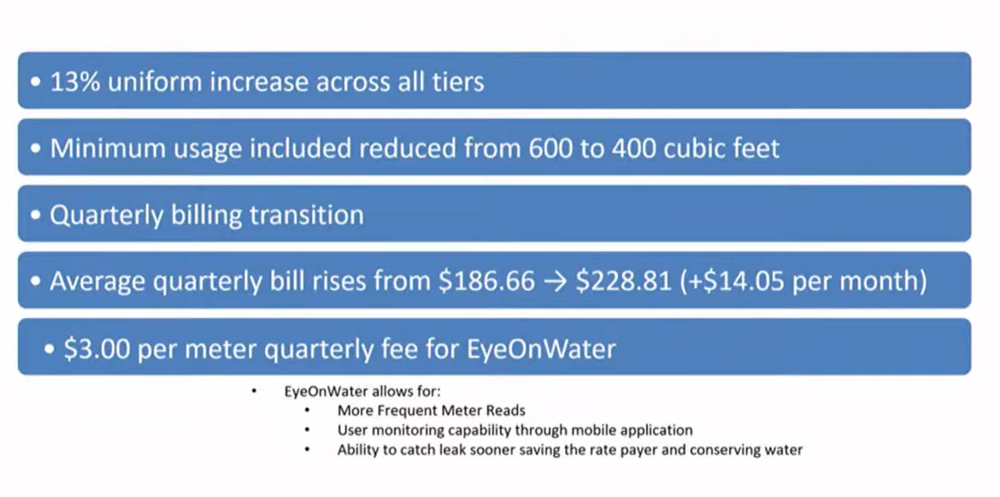 Proposed methods to save money and improve reserves.
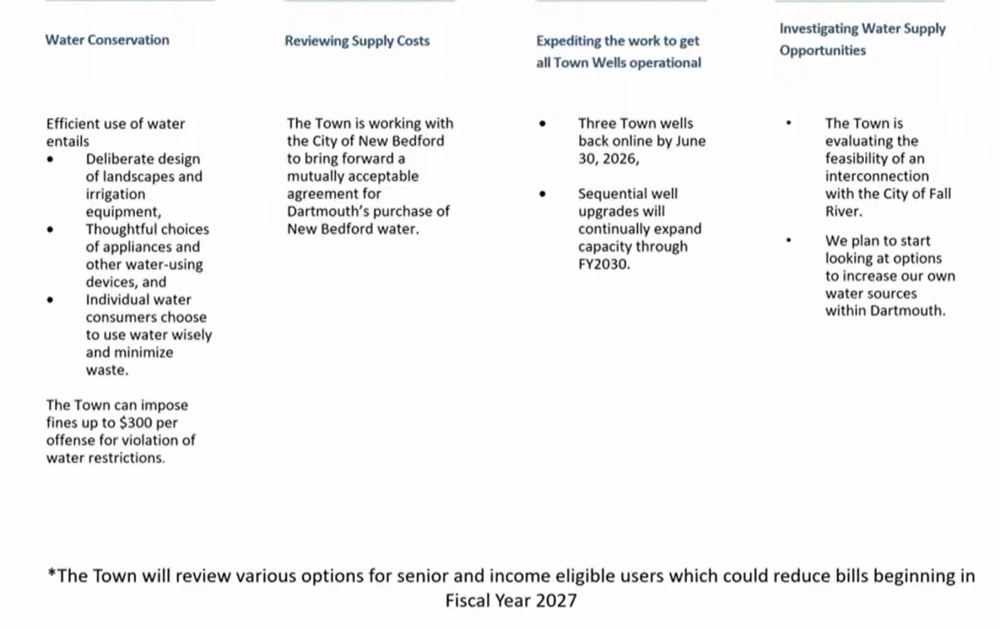 Haddad focused on four areas of focus for ways of addressing Dartmouth's water needs.
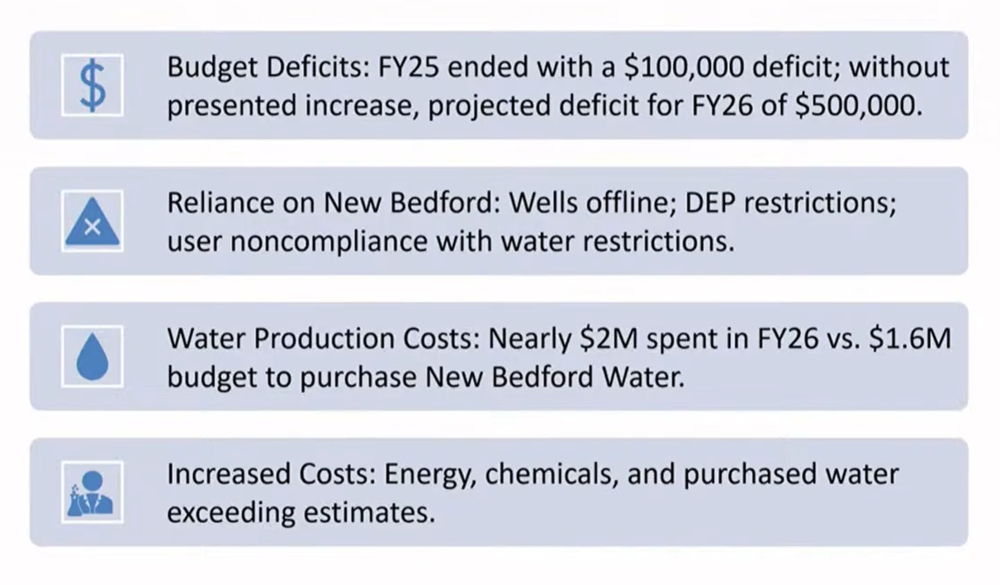
Four areas where heightened expenses are found. Source: DCTV
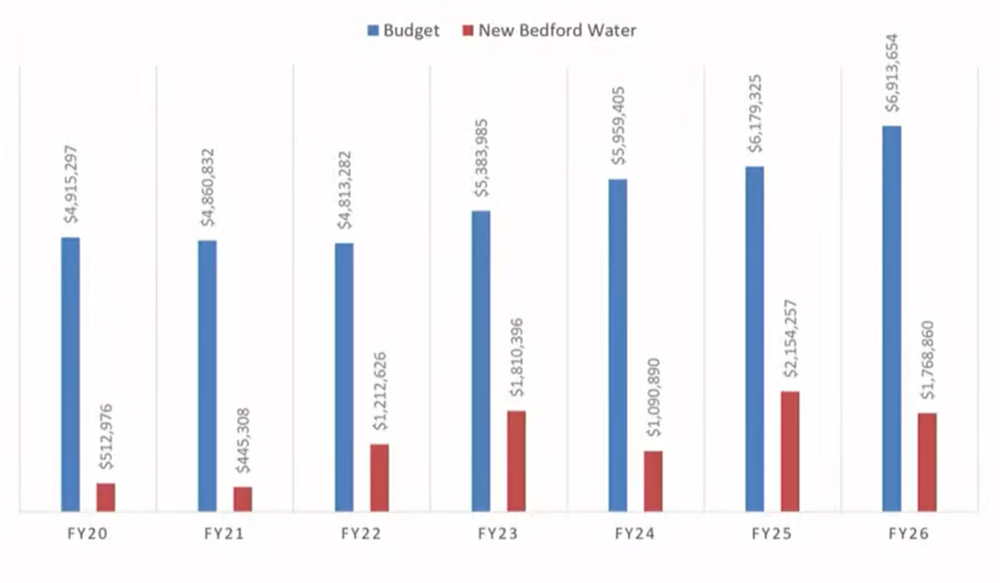
The change in how much Dartmouth has paid New Bedford for water compared to the budget from 2020 through the present fiscal year.
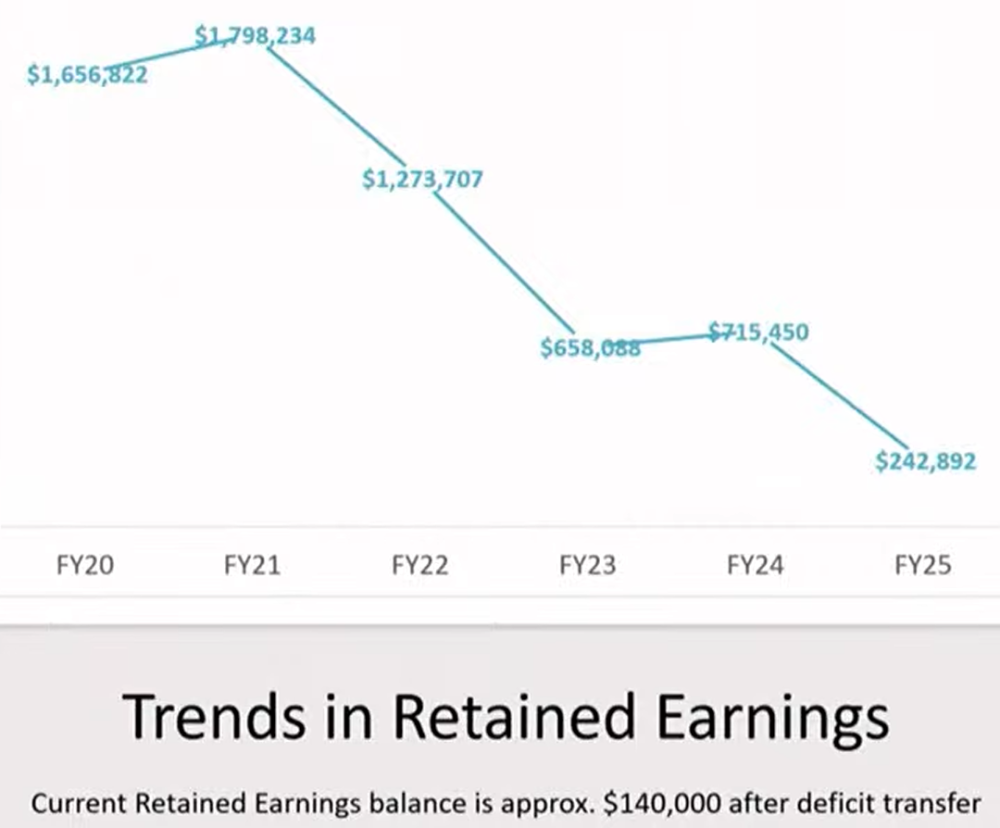
Retained earnings have been decreasing since Fiscal Year 2020 with the current retained earnings balance approximately at $140,000.
A comparison of how many gallons of water were used each month in 2024 versus 2025.
Proposed methods to save money and improve reserves.
Haddad focused on four areas of focus for ways of addressing Dartmouth's water needs.
Haddad focused on four areas of focus for ways of addressing Dartmouth's water needs.
Four areas where heightened expenses are found. Source: DCTV
The change in how much Dartmouth has paid New Bedford for water compared to the budget from 2020 through the present fiscal year.
Retained earnings have been decreasing since Fiscal Year 2020 with the current retained earnings balance approximately at $140,000.
A comparison of how many gallons of water were used each month in 2024 versus 2025.
Proposed methods to save money and improve reserves.
Haddad focused on four areas of focus for ways of addressing Dartmouth's water needs.
Water rates may be increasing by 13% as town officials work to address a deficit in the town's Water Enterprise Fund. This would on average raise rates by $14.05 per month in a quarterly billing system.
During the Fall Town Meeting, members voted to transfer over $100,000 from the Water Enterprise Fund to cover a deficit from Fiscal Year 2025 — a vote that was required to pass to cover costs and left the retained earning balance at approximately $140,000.
According to Town Administrator Cody Haddad, if rates don’t increase the town could face a $500,000 deficit for Fiscal Year 2026.
If the 13% increase goes into effect, the town is projected to break even this year and then begin building up retained earnings in Fiscal Year 2027, according to Haddad.
Haddad attributed the deficit largely to an increase in purchasing water from New Bedford.
“One of the primary drivers of why we’re here tonight is the purchase of water from the city of New Bedford,” he said during a Select Board meeting on Monday, Dec. 15.
From Fiscal Year 2020 Dartmouth went from paying $512,976 to New Bedford for water to $2.2 million in 2025.
In Fiscal Year 2026, which began on July 1, the town has already spent $1.8 million for water from New Bedford.
“We budgeted $1.6 million … so we’re already over budget, and we anticipate that to only increase due to several factors,” Haddad said.
Other factors include a general reliance on New Bedford due to Dartmouth wells being offline, Department of Environmental Protection restrictions and user noncompliance with water restrictions.
Haddad explained that between May and September a number of the town’s wells are required to be shut down, depending on drought conditions.
“If they reach a certain level and that gets too low, we have to shut down our wells during peak demand for water,” he said, “And essentially that means more reliance on the city of New Bedford.”
Haddad said the town anticipates getting three wells back online by the end of Fiscal Year 26, which ends on June 30.
“We are also looking at several other upgrades through Fiscal 30, which would essentially increase capacity in what we draw from our wells,” he added.
Water restrictions go into effect every season, meant to limit the timeframe for watering between the hours of 5 p.m. and 9 a.m.; however, this isn’t something that everyone always abides to.
Haddad noted that the town also faces increased costs for energy, chemicals and purchased water that have exceeded estimates.
“Just like our residents see an increase in their cost of electric, natural gas, we see that in our Water Enterprise Fund,” he said.
He noted that wells in pump stations can require a lot of energy, which means that when energy costs increase, there is a larger burden on the budget.
The water rate increase from the city of New Bedford also outpaces what the town of Dartmouth increased rates to when they were set for Fiscal Year 26, which was established before New Bedford set its water rate.
“We are working towards renegotiating an agreement with [New Bedford] that is mutually agreeable for both the town of Dartmouth and the city of New Bedford, and the goal with that would be to potentially reduce the rate that we are paying them,” Haddad said.
Besides raising water rates, Haddad also proposed a $3 per meter quarterly fee for EyeOnWater — a system that allows for more frequent meter reads, user monitoring capabilities and an ability to catch potential leaks.
He also mentioned reducing minimum use from 600 to 400 cubic feet, heavily imposing water restrictions for $300 per offense, and encouraging residents and community members to be more diligent about water consumption year round.
“It really comes down to individual water consumption,” Haddad said.
He noted that the town used 30 million more gallons of water this August than in August 2024.
“That’s a problem, particularly as homes become more efficient, businesses become more efficient, we shouldn’t be seeing more water here,” he said. “Essentially we should be seeing less water usage.”
The Board of Public Works will continue discussing water rates at its next meeting on Thursday, Dec. 18.