











Residents concerned with how 40B housing conversations are handled
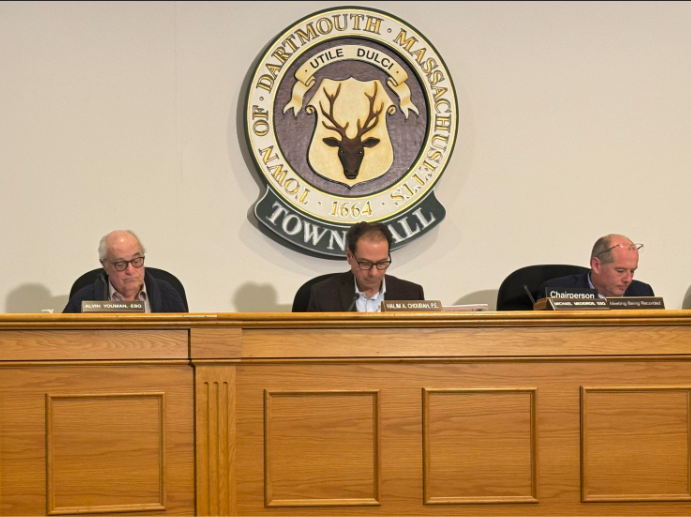 The Zoning Board of Appeals on Thursday, Jan. 8. Photo by Kat Sheridan
The Zoning Board of Appeals on Thursday, Jan. 8. Photo by Kat Sheridan
The Zoning Board of Appeals on Thursday, Jan. 8. Photo by Kat Sheridan
During Zoning Board of Appeals meetings, the room in Town Hall is often packed with residents — sometimes overflowing into an additional room — who are there to hear about housing project logistics and voice their opinions.
But at a meeting held on Thursday, Jan. 8 where a 300-unit project called The Hathaway was presented for the first time, those in attendance were left without an opportunity to comment on the project. This isn’t uncommon, as the board wanted to allow the developer to fully introduce the project.
While the meeting was advertised as a public hearing, the board isn't legally required to allow public comment, according to Sydney Weiser, the press secretary for the Office of Massachusetts Attorney General.
Resident Daniel Rodrigues was among the residents who attended the Jan. 8 meeting expecting there to be public comment.
"I don't think the town is being transparent with what is going on," he said.
He said that he was concerned by the lack of acknowledgement of written letters of concern, noting that his neighborhood sent in a petition signed by over 30 people detailing their concerns that hadn't been read into record, though the Zoning Board did acknowledge that they received it.
“The neighborhood was concerned that the town did not fully investigate all the safe harbors available to them,” Rodrigues said.
While the Zoning Board allows comments at a majority of the meetings, they sometimes don't allow public comment due to time constraints and the quantity of people looking to speak.
“It’s just to assist in moving the hearings forward as far as allowing the petitioners to actually present their case,” said Zoning Board Chair Michael Medeiros. “I’d like to handle it more as if it were a court case, where you have one side actually present their case so we know exactly what it is they’re seeking to have done.”
Many who show up to comment at Zoning Board of Appeals meetings have concerns because they live near the site of a proposed project, including Carol Cherbitsky Cabral.
Cherbitsky Cabral lives on Little Lucy Road near the site of the proposed Sherbrooke Farms, a 152-unit project on Old Westport Road.
“I’m curious as to whether the state knows what’s going on [at the property of Sherbrooke Farms,] what’s been buried over here, that this is an aquifer district and that it’s going to put a stress on the water … traffic and parking,” said Cherbitsky Cabral.
Cherbitsky Cabral said, “I almost think [the project] is out of [the Zoning Board’s] hands. I think the state mandates 40B and they can go beyond things.”
Chapter 40B was written to promote affordable housing and requires that at least 10% of a town’s housing is affordable. Under Chapter 40B, the state can override local zoning laws and approve a housing proposal if at least 20-25% of the units are affordable.
The Zoning Board can place restrictions on construction, but the Massachusetts Housing Appeals Committee can override vetoes and approve a project.
The role the state plays in mandating 40B is a concern shared by members of the Zoning Board.
“It’s an unfortunate predicament that our community finds itself in, and I think that people of the town are in a better position to make determinations as to what type of growth and development should occur in any given area of the town versus having the state, in essence, allow developers to make the decision for us,” said Medeiros.
He said he promises that he won’t close public hearings until every person has had their voice heard and that he sympathises with those who are upset about the developments.