











Guide for early voting
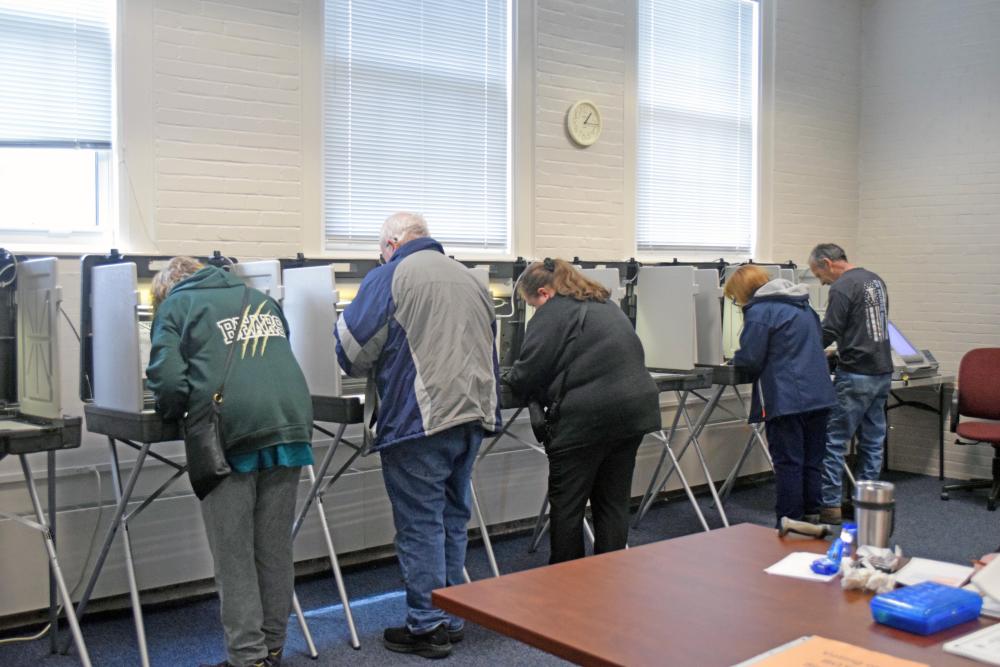 People vote during the Town Elections at Town Hall. Photo by Kat Sheridan
People vote during the Town Elections at Town Hall. Photo by Kat Sheridan
People vote during the Town Elections at Town Hall. Photo by Kat Sheridan
Early voting for the November elections begins on Saturday, Oct. 17 and will run until Oct. 30.
Early voting at Town Hall will happen during business hours and on weekends from 9 a.m. to 1 p.m. Town Hall is open from 8 a.m. to 6:30 p.m. on Monday, 8 a.m. to 4:30 p.m. Tuesday to Thursday and 8 a.m. to 11 a.m. on Friday.
Mail-in ballots have already been mailed out. Those who signed up to vote by mail can mail their ballots in the provided envelope or drop them off at a ballot box within a week of election.
The last day to register to vote or make changes to the voter registration form is Saturday, Oct. 24 at 5 p.m. This can be done at the Town Clerk’s office, which is in Town Hall Room 203 or online at sec.state.ma.us/OVR/.
There are nine voting precincts in Dartmouth, and voters can find their voting location at .sec.state.ma.us/WhereDoIVoteMA/WhereDoIVote.
Voters in Dartmouth will be voting for 14 offices, 11 of which are contested. They are as follows:
-
Senator in Congress: Edward Markey (Democrat), John Deaton (Republican), Shiva Ayyadurai (Independent), Joe Tache (Socialism and Liberation)
-
Governor and Lieutenant Governor: Maura Healey and Kimberly Driscoll (Democrat), Mike Minogue and Shawn Oliver (Republican), Andrea James and Kayla Kittredge (Independent)
-
Attorney General: Andrea Joy Campbell (Democrat), Michael Walsh (Republican)
-
Secretary of State: William Francis Galvin (Democrat), Anne Brensley (Republican)
-
Treasurer: Deborah Goldberg (Democrat), Elizabeth Dionne (Republican)
-
Auditor: Diana DiZoglio (Democrat), Al Ozonoff (Libertarian)
-
Representative in Congress: Bill Keating (Democrat), R. Tyler Macallister (Republican)
-
Senator in General Court: Mark Montigny (Democrat), Robert Scott McConnell (Republican)
-
Representative in General Court: Ed Pacheco (Democrat), Chester Tam (Republican)
-
District Attorney: Seth Thomas Aitken (Republican), Christopher Markey (Democrat)
-
Registrar of Probate: Thomas Cleary Hoye (Democrat), Melanie Patenaude Layden (Independent)
There will be nine questions on the ballot this year. Each question will have a small summary of what the question is asking. The last time there was this long a ballot was around the 1970s.
Residents can bring a paper with their plans, which is provided in the Red Book mailed to all Massachusetts residents. If that has already been thrown out, residents can bring a cheat sheet or their phones into the voting booth.
The Dartmouth Week has given a summary of each question and what a yes or no vote would mean. For a more detailed summary, including who is endorsing each question and what the current law is, visit sec.state.ma.us/divisions/elections/download/information-for-voters/archive/IFV_2026%20English.pdf.
-
Public Records: The first question is asking whether to make changes to the law surrounding public records. Voting yes will make records held by the Legislature and the Office of the Governor public. Certain documents would be exempt, including development of public policy and communications between legislators and constituents. Voting no would make no difference to the current law.
-
Collective Bargaining: The second asks if voters approve of a law surrounding the Committee for Public Counsel Services. A yes vote would allow the Committee to form a union to collectively bargain with an employer, execute a collective bargaining agreement and request necessary appropriation. Voting no would make no change to the current laws.
-
Primary Election Changes: This question asks if voters approve of having political party primaries for state elections. Voting yes would get rid of political party-based primaries, meaning all the candidates would appear on the primary ballot and the top two candidates would appear on the November ballot. This would also mean governor and lieutenant governor would run and be listed together and would provide political party status to candidates who receive 3% of the vote in the state primary. Voting no would make no changes to how voting works.
-
Registering to vote: This question would change how people register to vote. A yes vote would allow eligible individuals to register to vote on the day of an election by signing a written oath and providing proof of residency. Without proof of residency, a person can cast a provisional vote, which would only be counted if they can prove residency within two days of a primary or six days of a state election. Residents would still not be able to change party affiliation the day of. This would go into effect on Jan. 1. A no vote would make no changes to how voting works.
-
State revenue: This question would change how much revenue the state can collect in a year. A yes vote would tie the limit to the prior year collections plus average wage and salary growth. Any excess collections would be refunded to the taxpayers the next year. This would also include revenue from surtaxes on incomes over $1 million. This would go into effect on July 1, 2027. A no vote would make no change to state taxes.
-
Nature for All Fund: This question would create a Nature for All Fund, which would be funded from 50% of state sales taxes on sporting goods, recreational vehicles and golf courses in their first year. After July of 2028 the fund would receive 100% of these sales taxes. This would exclude revenue from the Massachusetts Bay Transportation Authority State and Local Contribution Fund and the School Modernization and Reconstruction Trust Fund. The Executive Office of Energy and Environmental Affairs could use this money for natural resource conservation. This fund could receive donations. Surplus funds from this could not be transferred, but public entities involved in conservation could receive funds. A 15-member Nature for All Board would be created, hired by the Executive Office of Energy and Environmental Affairs, who would create annual reports on the funds. A no vote would not create this and keep sales taxes on these goods as they are.
-
Increasing housing: This question would lower the amount of land required for single family houses in residentially zoned areas with access to public sewer and water to 5,000 square feet. The land would need 50 feet bordering the street or public way. The Zoning Board could reasonably regulate other aspects like height, distance from neighbors, open space, parking and renting. The Executive Office of Housing and Livable Communities could give guidance on regulations to the law. A no would make no changes to current zoning laws.
-
Marijuana sales: This question would change the amount marijuana a person over 21 could possess to one ounce or less, including five grams of concentrate. Possession of marijuana over this amount would impose a civil penalty of $100 and require forfeiting the marijuana, and for those under 21 would impose the fine and forfeit as well as completion of a drug awareness program, community service and notification to legal guardians. Current dispensaries would operate on an expedited basis to become medical dispensaries and sell the rest to medical dispensaries. A no vote would keep dispensaries and current marijuana laws.
-
Gun laws: This question would implement changes to current gun laws. A court can order the surrender of firearms when school administrators or licensed healthcare providers are concerned or during a Harassment Prevention Order. The firearm licensing requirements would change to allow local licensing authorities to request prior license and permit information and petitions for involuntary mental health commitments and require someone to be 21 to own semiautomatic rifles or shotguns. It would allow incarceration of up to six months for failing to report the loss or theft of a firearm. It would be legal for 12-15 year olds to apply for a self-defense spray permit with parental permission and 15-18 year olds to apply. The definition of machine guns would include bump stocks, trigger cranks, Glock switches and auto sears. The definition of a silencer would include parts used to construct one. It would determine what an assault style weapon is and the conditions in which a person can keep the ones they own. IT would prohibit carrying firearms in government buildings, polling locations and schools (with exceptions.) The law would expand data compilation and reporting, and would create a commission to examine funding for violence prevention, and a commission to study new firearm technology. A no vote would not just not pass these changes, but repeal aspects of the current law that were passed in 2024. Currently, there are penalties for possessing, creating or transferring ghost guns and require all guns besides antiques and relics to have serial numbers. Local licensing authorities have to transfer firearm dealer inspection to the police, and require the licensing authorities to attend statewide training. Dealers need to confiscate expired or suspended licences and report them. The Firearm Control Advisory Board and Secretary of Public Safety and Security review and update rosters of prohibited and allowed firearms. It is also illegal to discharge a firearm and strike a building. The State Police also provide training cards and test new applicants.