











Bristol County District Attorney ordered to test DNA from a 1988 Dartmouth murder
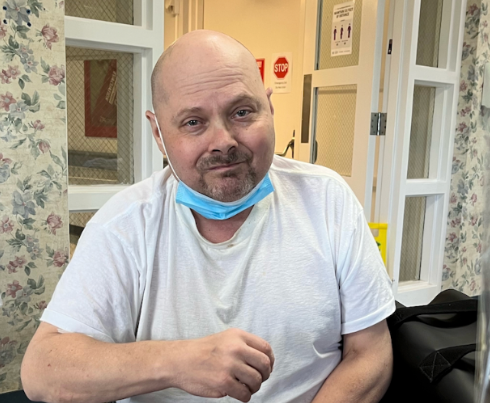 Shawn Tanner, while released on medical parole, shortly before his untimely death in 2022. Source: New England Innocence Project
Shawn Tanner, while released on medical parole, shortly before his untimely death in 2022. Source: New England Innocence Project
Shawn Tanner, while released on medical parole, shortly before his untimely death in 2022. Source: New England Innocence Project
Thirty-seven years after Shawn Tanner of Dartmouth was convicted of murdering a sex worker in Dartmouth and five years after requesting DNA testing, the Supreme Judicial Court of Massachusetts ruled on Friday, Feb. 27 that the Bristol County District Attorney’s Office must DNA test the evidence.
The New England Innocence Project represented Tanner’s case back at the Supreme Judicial Court, after the District Attorney's office brought it to the court to overturn a previous order from the Superior Court to test the evidence. The New England Innocence project stated that the forensic testing that put Tanner away in 1989 was proved faulty and that regardless of his death, evidence should still be tested for DNA, and has offered to cover the costs of the tests.
In 1988, Tanner — who died in September 2022 from brain cancer — was accused of the murder of a sex worker, identified as “M.H.”
M.H. was killed in the same period of time that the “Highway Killer,” who murdered nine sex workers or women with addictions and left their bodies along the highway, was active. Only one of the Highway Killer victtims were found before Tanner was arrested in connection to M.H.'s death, according to Laura Carey of the New England Innocence Project.
M.H. worked at The Kings Inn in Dartmouth, where Tanner worked as a bouncer. On the morning of April 28, 1988, they ate at a local restaurant and returned to her motel.
At the time, Tanner said they then smoked marijuana, unsuccessfully tried to buy cocaine from his acquaintance Steven Almeida and had sex for money. He said he left when a man he didn’t know came into the room. According to Tanner, M.H. was alive when he left.
M.H. had been found with stockings tied around her neck later that day, and an autopsy confirmed she died from asphyxiation.
At the time, Almeida said that Tanner admitted killing M.H., and that Tanner told him M.H. had refused to have sex with him as he didn’t have any money, but that he had sex with her anyway. Almeida also said that Tanner bought cocaine using a diamond ring and a gold bracelet of hers. Almeida said Tanner had hid two other rings in the men's room of the restaurant, which police found.
Tanner was indicted in May of 1988 and convicted in September of 1989. He had pleaded innocent, and maintained his innocence until he died in 2022 from an aggressive brain cancer.
Tanner reached out to the New England Innocence Project to attemt to prove his innocence. They found out that DNA from the scene had been preserved and announced he intended to request it be tested, which District Attorney Thomas Quinn declined.
There was a lot of preserved evidence; the stockings used as a ligature; fingernail scrapings from the victim’s hands; two blood-stained sheets; two towels found near the victim; hairs collected from M.H.’s bed sheet and towel; M.H.’s genital wash and swab and rectum swab; swab from the victim’s breast and two rings allegedly stolen from M.H.
The Superior Court decided in May 2022 that the DNA should be tested, saying the objects may have been handled by others besides Tanner and M.H. The district attorney, regardless of months of protest and court hearings, agreed to pursue testing.
The testing was continually postponed, both before and after Tanner’s death, regardless of acknowledgement of his short life expectancy. Some evidence has never been sent to the private testing lab Bode Technology Group, Inc., specifically fingernail scrapings, according to court records.
“We don’t have any idea why, and we have not heard them articulate in their briefings or before in the arguments before the SJC that happened in the fall the reason why that might be the case,” said Carey
In court records, the district attorney’s office stated that since Tanner is dead, there can be no possible relief for him.
“We feel the truth is worth pursuing, no matter the circumstances,” said Carey. “Shedding light on what might have happened is important for the integrity of the system, and there’s a possibility that the real, the true, perpetrator could be identified through testing.”
The New England Innocence Project isn’t the only one in favor of testing the DNA, with Tanner’s sister Cheryl, and two family members of victims of the Highway Killer also releasing statements of support in court.
According to Carey, it’s likely that Tanner’s DNA will be present in the evidence since he was at the scene of the murder. However, it’s also possible that investigators may find another person’s DNA who could be connected to the murder.
In 2023, the Supreme Judicial Court ruled it served public policy to DNA test the evidence. The District Attorney's office brought the matter to the Supreme Judicial Court on Nov. 3, 2025 to try and overturn the previous order.
"It is the right of each party to seek the Court’s guidance on legal matters or statutory interpretation through the appellate process," said District Attorney's Office, "This is precisely what the BCDAO undertook in this matter. Now that the SJC has provided legal clarification regarding the statute, we will comply with the Court’s ruling."