











Discussions for The Hathaway begin in the Zoning Board
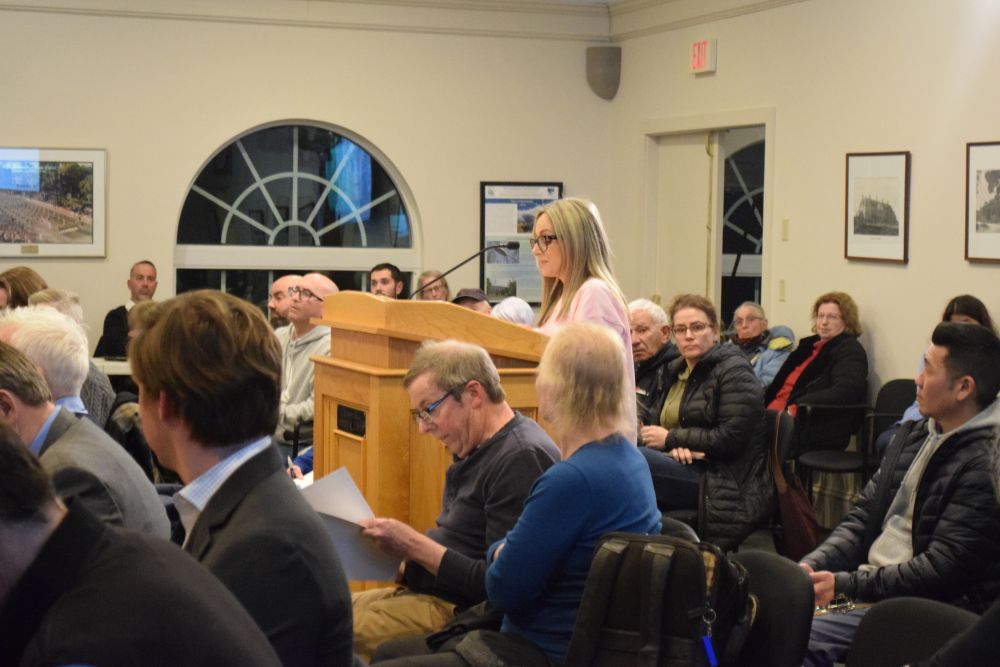 A resident argues against the Hathaway. Photos by Kat Sheridan
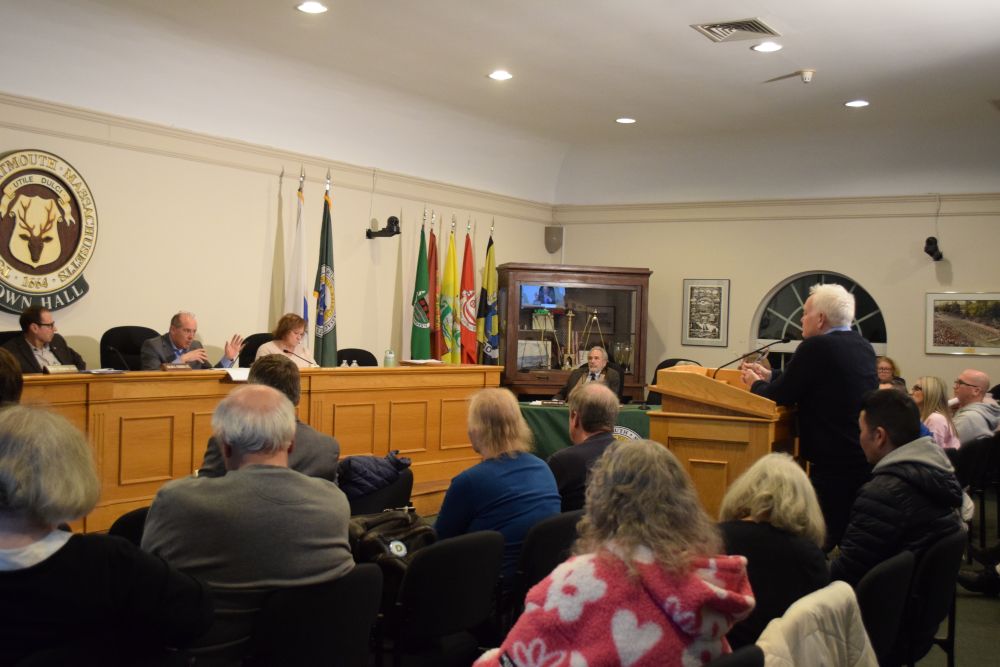 Michael Medeiros and Dave Calhoun argue over details of the proposed apartments.
 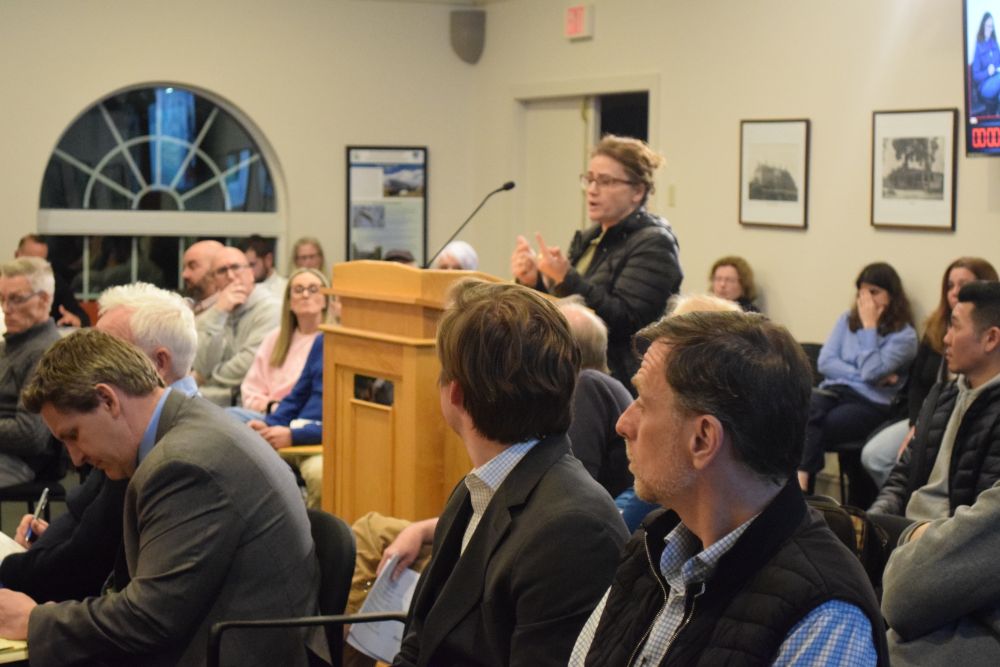 A resident argues against the Hathaway.
 Photos by Kat Sheridan
Michael Medeiros and Dave Calhoun argue over details of the proposed apartments.
A resident argues against the Hathaway.
A resident argues against the Hathaway.
A resident argues against the Hathaway. Photos by Kat Sheridan
Michael Medeiros and Dave Calhoun argue over details of the proposed apartments.
A resident argues against the Hathaway.
The developers of The Hathaway, a 300-unit 40B apartment complex proposed for Hathaway Road, presented their traffic and civil studies at the Monday, March 2 Zoning Board of Appeals meeting.
This would be a 40B project, which allows the developers to bypass certain zoning laws if at least 25% of the property is deemed affordable. There will be 75 apartments deemed affordable in The Hathaway.
During the meeting, the traffic consultant for the developers, Jeffery Dirk of Vanasse and Associates, presented their traffic study findings.
The study was conducted in early November across two days, and included Route 6 at Hathaway Road and at Slocum Road; Hathaway Road at Slocum Road, Wilbur Avenue and at the 140 Southbound and Northbound ramps.
These areas were found to have crashes at a higher rate than the Massachusetts average, according to data taken between 2018 and 2022.
The study showed that people typically went 44 miles per hour rather than the posted 40 speed limit. On average, there are 29,000 cars traveling these roads every day.
The study didn’t factor in the proposed sale of the Whaling City Golf Course to turn it into a business park with businesses, medical offices, retail and more. This was due to the fact that the plans for the Whaling City Golf Course had not received any city approvals at the time of the traffic study, and so the developers did not have to include the traffic data for the golf course in their study.
To prevent further traffic, they would put a stop sign at the entrance to the apartments, and request more stop signs at intersections around town such as at Hathaway and Slocum Road and Hathaway and Wilbur Avenue. They also recommended more safety measures such as implementing a better timed traffic light system at Route 6 and Slocum Road.
Dirk stated that with the road improvement project proposed by the Massachusetts Department of Transportation for Route 6, planned for 2027, that their apartments will not be as much of a traffic problem.
Apartment complexes similar in size to The Hathaway were found to add 1,338 cars a day during the weekdays, with 118 in the morning and 111 at night during peak hours.
“If you have more cars you’re going to have more traffic in here, we’re adding more cars because there’s going to be more units,” said Michael Medeiros, the chair of the Zoning Board.
The developers plan to have 341 parking spots but would expand to 428 if these are not enough spaces. Additional parking would be near Hope Evangelical Community Church.
Dirk said the buildings would be built tall to conserve the wetlands behind the planned development. They also requested a variance to build a billboard, which he said could generate funds to donate for wetlands efforts. Developer Dave Calhoun stated they have already discussed this with the Dartmouth Natural Resources Trust.
For stormwater retention, there will be three subsurface chambers that will treat the water before it goes downhill to the wetlands.
Phillip Cordeiro, the civil engineer, assured residents that water wouldn’t flow into the neighboring Eisenhower Drive, as the retention basins would prevent it from flowing anywhere but the wetlands or into the ground.
The developers are working with the Department of Public Works to coordinate the possibility of connecting to town water and sewer.
The layout of the six buildings would be four stories at the front, with five stories toward the back to accommodate for the natural slope of the land. The fronts of the buildings would be 44 feet tall, and 55 feet at the back.
There would also be a sports court on the border between the apartments and Hope Evangelical Community Church, with the agreement that the church could use the court for their youth groups and clubs. The plans also include a dog park, pool and an amenities building.
The peer review consultant for the town, Deborah Keller of Merrill Engineers and Land Surveyors, stated that the majority of their civil plans are good. However, she pointed out that they need to look into the constructionability of their retaining walls to know how they will be built, their snow storage plans and lighting fixture heights.
The main civil concerns brought forward were about building height and lighting causing privacy issues, as well as the fact that the wetland study was reviewed from 2014 rather than re-done.
Medeiros asked that Calhoun provide the number of apartments if the buildings were changed to three and four stories.
“That’s not the product we’re trying to build, we’re trying to build a high class product that people want,” said Calhoun. He added that he has no obligation to provide a model of three and four story buildings, as he applied for four and five story buildings.
On Monday, April 6, the peer review consultant for traffic will review the traffic study.
Many residents came forward to comment on issues with the traffic study, which Medeiros asked that they hold until April when the peer review study has been completed.
Some of the issues that will be brought forward at the next meeting are how dangerous Hathaway Road can be — which one resident described as a “death trap” — the traffic the complex could cause and the lack of parking.
At the next meeting, the developer will provide a model of the view from Eisenhower Road to show how it would be affected by the buildings.